India’s Thin State
Too Few Public Servants, Too Well Paid

This is a longer version of my recently published Op-Ed in the New Delhi daily the Pioneer
For much of the past three decades, India’s reform conversation has revolved around a familiar proposition: the state is too large, too cumbersome, and too expensive. From this follows an equally familiar policy instinct - privatise, outsource, rationalise, and reduce. The public sector, in this view, is a drag on growth and a burden on the exchequer. It is the old story of the bloated state surviving long after liberalisation.
But this diagnosis does not fit the facts. India’s central governance problem is not an oversized state. It is a thin state: a state with too few public employees in critical delivery roles, too little technical depth in many key institutions, and a compensation structure that makes expansion more difficult than it should be. India is not suffering from an excess of state presence. It is suffering from an absence of it where it matters most.
Too few
That absence is easy to miss because India is such a large country that even a relatively small public sector appears large in absolute numbers. According to the World Bank’s Worldwide Bureaucracy Indicators, as presented in Our World in Data, India employed 3.3% of total workers in the public sector in 2022, counting government and public enterprises. In the same year, the country’s labour force stood at 567.4 million, while the employed workforce was 495.5 million. In raw numbers, that still implies millions of public employees. But the important fact is the ratio, not the headline headcount. Relative to the size of its labour market, India has one of the leanest public sectors among major Asian economies. The same 2022 World Bank series places China at roughly 23%, South Korea at about 10.7%, Indonesia at about 8.9%, and Japan and Vietnam at about 7.9%. Even allowing for some definitional noise in cross-country data, the comparative pattern is unmistakable: India employs a much smaller share of its workforce in the public sector than the Asian states it is often compared with. Our World in Data ILO
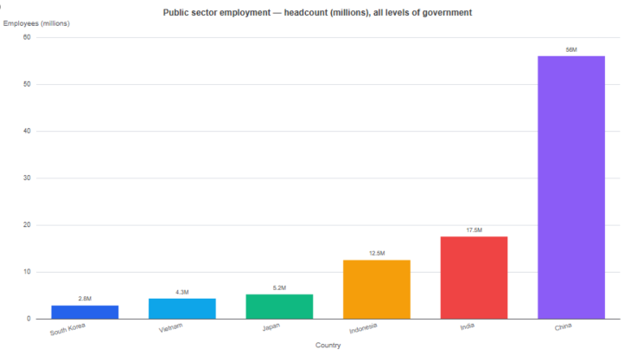
This matters because states do not govern in the abstract. They govern through people. A welfare scheme exists only if there is someone to administer it. A school functions only if there is a teacher in the classroom. A health centre is only as real as the nurse, technician, or doctor who shows up for work. A legal right has practical force only if there are enough judges, clerks, and police personnel to make enforcement plausible. When the number of public employees is too small relative to the functions assigned to the state, policy ambitions become detached from implementation capacity.
That is the real Indian problem. The state promises more than its staffing structure allows it to deliver. It legislates expansively, announces repeatedly, and schemes ambitiously. But it often lacks the dense administrative base required to translate policy into outcomes at scale. The result is a familiar pattern across sectors: a gap between announcement and execution, entitlement and access, regulation and enforcement.
The most important deficits lie at the implementation layer. Public debate in India often overemphasises the top of the bureaucracy - the elite civil servant, the reform-minded secretary, the district magistrate with a reputation for competence. But the everyday effectiveness of the state depends far more on the less glamorous layers beneath them: teachers, nurses, anganwadi workers, constables, clerks, inspectors, engineers, lab technicians, agricultural extension workers, and court staff. These are the people who convert policy into service delivery. If they are too few in number, no amount of brilliance at the top can compensate.
The shortages are visible in hard institutional ratios. In policing, a widely cited PRS summary drawing on official data noted that in 2016 India’s sanctioned strength was 181 police per lakh population, but after accounting for vacancies the actual strength fell to 137 per lakh. The same note cites the United Nations benchmark of 222 police per lakh population. That benchmark should be used carefully - it is a recommended reference point, not a magic universal optimum - but it is still useful in showing the scale of India’s gap. The judiciary shows a similar pattern of thinness. In a Lok Sabha reply answered in February 2024, the Government of India stated that the country had approximately 21 judges per million population, calculated using 2023 sanctioned strength across the Supreme Court, High Courts, and district and subordinate courts, benchmarked against the 2011 Census population base. The same reply recalled the long-standing target, endorsed in judicial discussions and Law Commission thinking, of 50 judges per million population. India is thus operating at well under half even its own often-cited adequacy benchmark. PRS Lok Sabha reply
These details matter because they clarify the nature of the capacity problem. India does not simply suffer from a vague administrative weakness. It suffers from a shortage of actual state presence in classrooms, police stations, courts, clinics, and field offices. A district collector cannot compensate for the absence of a teacher in a village school, a nurse in a primary health centre, or a judge in a congested trial court. Administrative excellence at the top cannot substitute for missing personnel at the base.
This is why the debate over state capacity has to distinguish between two different problems. One concerns the quality, training, and specialisation of higher civil services. The other concerns the numerical sufficiency of frontline and mid-level public employment. These two problems are related, but they are not substitutes for one another. India can hire more lateral experts into ministries, expand domain knowledge at senior levels, and improve policy design - all worthwhile reforms - and still fail at basic delivery if local schools, health centres, police stations, and lower courts remain understaffed. Conversely, simply adding personnel without improving institutional quality and management will not produce a capable developmental state either. The challenge is dual: India needs a more specialised state at the top and a denser one at the base.
Too well paid
What makes the Indian case especially unusual is that this thinness coexists with relatively high pay. The problem is not only that India employs too few public servants. It is also that the state pays them at levels that are high relative to the median worker in the surrounding economy. A 2005 World Bank study by Elena Glinskaya and Michael Lokshin estimated that India’s public-sector wage premium ranged from 62% to 102% over the private-formal sector and from 164% to 259% over the informal-casual sector, depending on the estimation method. These figures are from an earlier period rather than a current-year snapshot, but they illuminate a structural feature of the Indian labour market that remains highly relevant: public employment is not only scarce and secure, but also positioned far above the earnings of most workers outside the formal sector. World Bank working paper
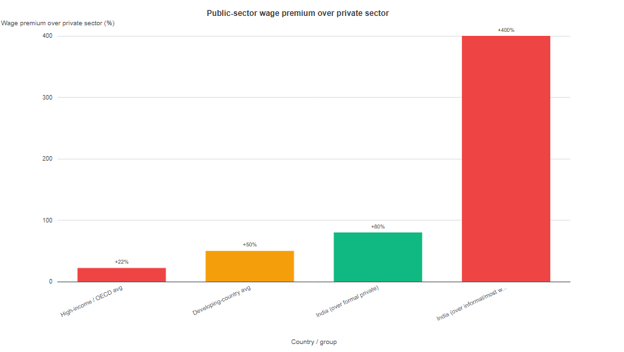
This does not mean ordinary government employees live lives of luxury. In absolute terms, many lower-level public servants earn middle-class rather than elite salaries, especially in urban India. But the relevant comparison is not with upper-middle-class private professionals. It is with the median Indian worker, most of whom are employed in agriculture, informal services, casual labour, petty trade, or low-productivity self-employment. In that context, the public-sector pay structure sits unusually high above the centre of the labour market.
The structural logic behind this is straightforward. Public pay in India is heavily shaped by formal-sector benchmarks and periodic pay commission revisions. But the formal sector constitutes only a minority of total employment. When compensation is calibrated to a relatively small, more secure, and more productive segment of the economy, the resulting wage structure becomes fiscally expensive in a labour market where the median worker earns much less. The state ends up paying each worker a premium it can afford only by keeping overall numbers low.
That trade-off has serious consequences. A country can spend a substantial amount on public wages and still have too few public employees if compensation per employee is high enough. In effect, India has drifted into a model of high pay for a relatively narrow public workforce, rather than moderate pay for a broader delivery apparatus. This is not merely a distributional concern. It is a core state-capacity problem. Every additional teacher, constable, nurse, or court employee becomes costlier to add. Over time, the wage bill constrains the expansion of headcount, especially in labour-intensive public services where capacity depends less on technology than on human presence.
The East Asian mirror
The East Asian comparison throws this weakness into sharper relief. Japan, South Korea, Taiwan, and later China did not industrialise merely by getting the state out of the way. They built public institutions with the administrative reach and technical competence to guide structural transformation. Their states coordinated capital, planned infrastructure, managed industrial policy, developed human capital, and enforced reciprocal discipline on firms. They did not succeed because they had a vague commitment to “good governance.” They succeeded because they had organisations staffed densely enough and skilfully enough to act.
India’s trajectory was different. The state that emerged after independence was interventionist in many respects, but uneven in capacity. It could regulate extensively without always being able to implement effectively. By the late twentieth century, much of that interventionist edifice deserved criticism. Liberalisation was necessary. But liberalisation solved only one side of the problem. It rolled back parts of an overbearing regulatory structure without fully building the state capabilities needed for a complex, globally integrating economy.
That is one reason the post-1991 Indian state often appears paradoxical: simultaneously intrusive and weak. It can demand permits, impose compliance burdens, or proliferate schemes, yet still struggle to provide clean urban governance, timely justice, effective primary education, reliable public health, or strategic industrial coordination. The problem is not simply “too much state” or “too little market.” It is a mismatch between what the state tries to do and what its institutional base allows it to do well.
China offers the starkest contrast. Its advantage is not merely that it has more officials in aggregate. It is that it possesses a layered administrative system extending deeply into local society, backed by specialised bureaucracies in infrastructure, planning, energy, finance, and industry. That institutional density gives it implementation muscle. India, by contrast, has often compensated for a thinner administrative structure through social intermediaries, contractors, non-state actors, and local informal networks. In some sectors, that has produced innovation and flexibility. But it also means the state frequently behaves more as a purchaser, coordinator, or sponsor than as a direct provider with strong internal delivery capacity.
There is nothing inherently wrong with hybrid delivery. Many successful states contract, partner, and decentralise. But these arrangements still require a capable state core - one able to write contracts, monitor performance, prevent capture, evaluate outcomes, and correct failure. A thin state struggles to do even that. Outsourcing is not a substitute for capacity when the state lacks the staff to supervise what it outsources.
The foreign-policy spill-over
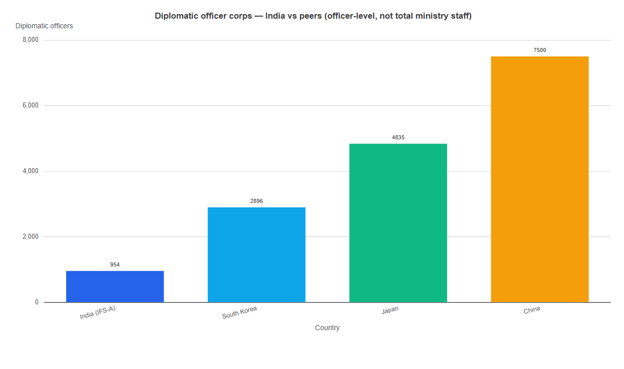
The implications are not confined to domestic policy. They are visible in foreign policy as well. India’s diplomatic machinery remains modest for a country of continental scale and rising geopolitical ambition. As of March 2024, the Ministry of External Affairs had a total in-person staff strength of 7,630, and the Indian Foreign Service had 1,011 officers. For a country seeking simultaneous influence in great-power politics, multilateral negotiations, technology diplomacy, trade strategy, regional crises, diaspora engagement, and development partnerships, that is a very small institutional base. A limited officer corps must divide its time among immediate strategic priorities, long-tail bilateral relationships, global governance forums, and increasingly technical issue areas such as climate finance, digital regulation, supply-chain resilience, and emerging technologies. Ambition outruns staffing. ThePrint
The same logic applies to the labour market more broadly. Expanding public employment is not a magic solution to India’s employment challenge, nor should it become a substitute for private-sector job creation. But that is not the relevant question. The relevant question is whether India currently has enough public workers to meet its own developmental and governance needs. On that count, the answer appears to be no. More teachers, nurses, constables, sanitation staff, court personnel, and technical officers would not be make-work. They would fill real gaps in state presence.
The unresolved challenge
Three decades after liberalisation, the deeper challenge therefore remains unresolved. India has become more market-oriented without becoming fully state-capable. Economic reform has moved faster than administrative reform. Growth has outpaced governance capacity. And the result is a state that is often too thin to deliver what a middle-income democracy of India’s scale now demands from it.
The lesson from East Asia is not that India needed less state. Nor is it that the answer lies in restoring an older model of control. The lesson is that development requires a capable state: one with enough people, enough expertise, enough institutional credibility, and enough implementation depth to convert national ambition into practical outcomes. For India, that means confronting both halves of the problem at once: an under-specialised apex and an under-staffed base.
Until that happens, India will continue to oscillate between overpromising and underdelivering. It will announce big goals with a machinery too thin to realise them fully. And it will remain trapped in a self-defeating argument about a supposedly bloated state that, on closer inspection, is often absent where citizens need it most.
Bibliography
Glinskaya, Elena, and Michael Lokshin. “Wage Differentials Between the Public and Private Sector in India.” World Bank Policy Research Working Paper 3574, April 2005. For the estimate that India’s public-sector wage premium ranged from 62-102% over the private-formal sector and 164-259% over the informal-casual sector, depending on estimation method. World Bank working paper
International Labour Organization. India Employment Report 2024: Youth Employment, Education and Skills. For India’s 2022 labour force of 567.4 million and employed workforce of 495.5 million. ILO
Ministry of Law and Justice, Government of India, Department of Justice. Lok Sabha Unstarred Question No. 1335, answered 9 February 2024: “Number of Judges per Million Population.” For the statement that India had approximately 21 judges per million population, calculated using 2023 sanctioned strength and the 2011 Census population base, and for the discussion of the 50 judges per million benchmark. Lok Sabha reply
Our World in Data, based on World Bank Worldwide Bureaucracy Indicators version 6. “Public sector employment as a share of total employment.” For the estimate that India’s public sector accounted for 3.3% of total employment in 2022, and for the cross-country comparison figures cited for China, South Korea, Indonesia, Japan, and Vietnam. Our World in Data
PRS Legislative Research. “Police Reforms in India.” For the 2016 figures showing India’s sanctioned police strength of 181 per lakh population, actual strength of 137 per lakh after vacancies, and the cited United Nations benchmark of 222 police per lakh population. PRS
ThePrint. “Understaffed MEA slowing down India’s sprint towards ‘Vishwa Guru’ status, but needle may be moving,” 8 March 2025. Citing parliamentary reporting for MEA total in-person staff strength of 7,630 and IFS strength of 1,011 as of March 2024. ThePrint
World Bank. Worldwide Bureaucracy Indicators Dashboard and Worldwide Bureaucracy Indicators (WWBI) Data360 dataset. For methodological background on comparative public employment, wage-premium, and public wage-bill analysis. WWBI Dashboard WWBI Data360
Absolutely on track . As a matter of fact entire bureaucratic structure shd be public service oriented with befitting designations but not colonial district magistrate kind of hang over which elicited feudal